The Suncamino partnership deck.
Not every deck is built to raise capital. This is one I helped Stewy & Inus build at Suncamino Rum as their brand-growth advisor — used to sign distribution partnerships in key markets globally. Slide by slide, with what works, where it could push harder, and what would make each slide even sharper.
Distributor names have been redacted so the deck reads as a template — Suncamino still uses the live version in active market conversations.
If you operate in the global spirits trade and want to talk about partnering with Suncamino — on-trade, retail, RTD, or all three — reach out to Stewy & Inus directly at stewy@suncaminorum.com or inus@suncaminorum.com.
How I'm reading this
- Different deck, different job. A partnership deck has to convert a different reader — the distributor's MD, not an investor. The currency is volume, doors, on-trade execution and shared risk, not equity returns.
- Symmetry sells the partnership. The slide where Suncamino commits €500K alongside the partner's €500K of services is the slide most decks don't have. Skin-in-the-game from both sides changes the whole conversation.
- Lifestyle first, spec second. Spirits buy on feeling. The deck opens with a surf shot, not a market chart, and that's right.
- Trade voice > consumer voice. A bartender or buyer quote beats a press quote in a partnership deck, because the partner is one of those people.
- Forcing functions close. Every \"are you joining us?\" slide I review benefits from a Calendly link and a tasting kit on the road within a week.
Want the redacted PDF?
Drop your email and I'll send you the redacted partnership deck.
Same 18 slides as below, in the original Suncamino layout — useful as a structural reference if you're building a partnership or distribution deck of your own.
One email, no list, no follow-up unless you ask. Privacy.
Slide 1 of 18
Cover — Suncamino Floral Rum × [Distribution Partner]
Worked. Co-branded cover. The "×" framing telegraphs intent in the first two seconds — this is a partnership deck, not a capital raise. The reader knows what room they're walking into before slide 2.
One thing to push. A partnership deck still benefits from a one-line hook on the cover. When the partner forwards this to a buying team, the second-degree reader at 11pm in their inbox needs the answer fast.
Even sharper. Small footer strip: "Premium South African floral rum. Multi-SKU lineup ready for [market]. Seeking on-trade + retail distribution." Keep the artwork; give the recipient a 5-second landing.
Slide 2 of 18
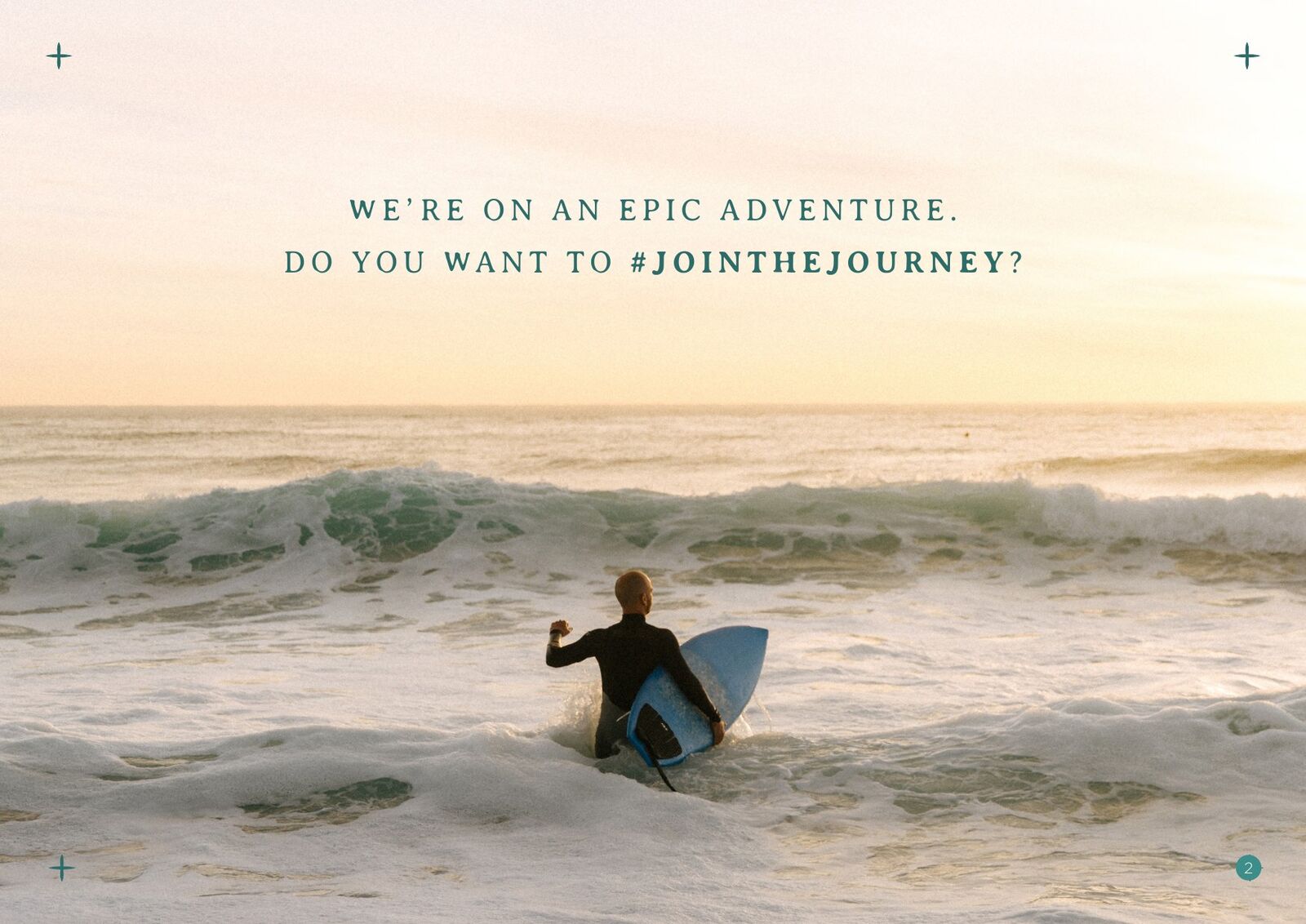
We're on an epic adventure — #JoinTheJourney
Worked. Identity-first opening. The partner sees the lifestyle they're being invited to sell before they see the product. This is how Patron, Casamigos and Aperol entered every market they did — feeling first, spec second.
One thing to push. The headline is brand voice. For a distributor, "why would I take this on?" wants an answer slightly faster than this. The hook can be commercial *and* poetic — it doesn't have to choose.
Even sharper. Keep the photo, swap the copy for the commercial line: "A premium category-creator. Founders co-investing 50% of the launch. Looking for the right partner to take it global." One sentence the distributor's MD can repeat in their head walking back to their desk.
Slide 3 of 18
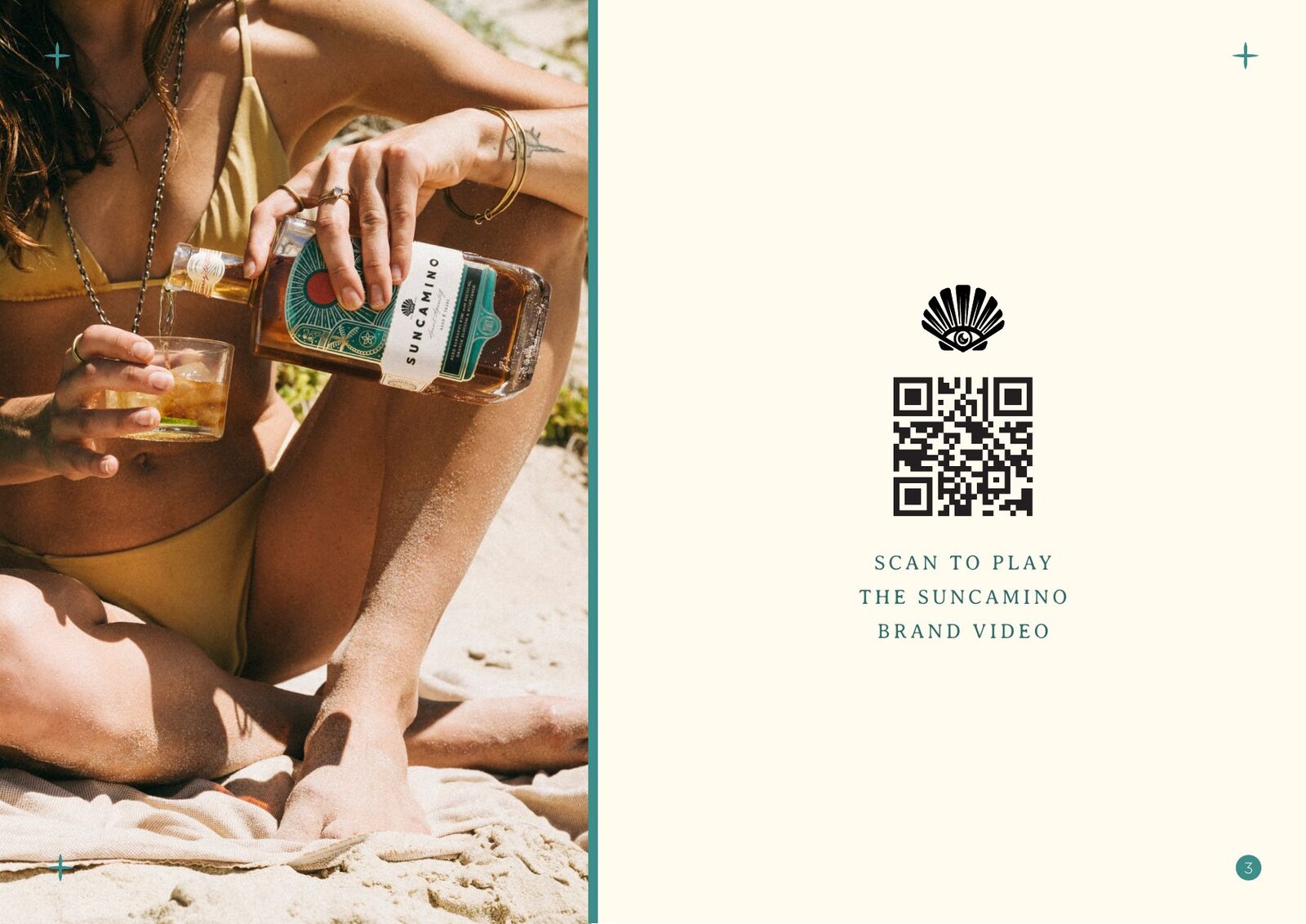
Scan to play the Suncamino brand video
Worked. Brilliant use of a slide. The distributor sees the lifestyle in motion — sound, colour, pace. QR codes inside physical decks beat URL paste-jobs in every meeting I've ever sat in.
One thing to push. QR codes assume the reader has the deck on a screen and a phone in the other hand. Half the time it's open on a laptop in a partner's office and the phone is on the desk charging.
Even sharper. Pair the QR with a short, memorable URL fallback — "suncaminorum.com/film" — so the laptop-reader has a one-click path. Bonus points if the film auto-plays without a YouTube/Vimeo wrapper around it.
Slide 4 of 18
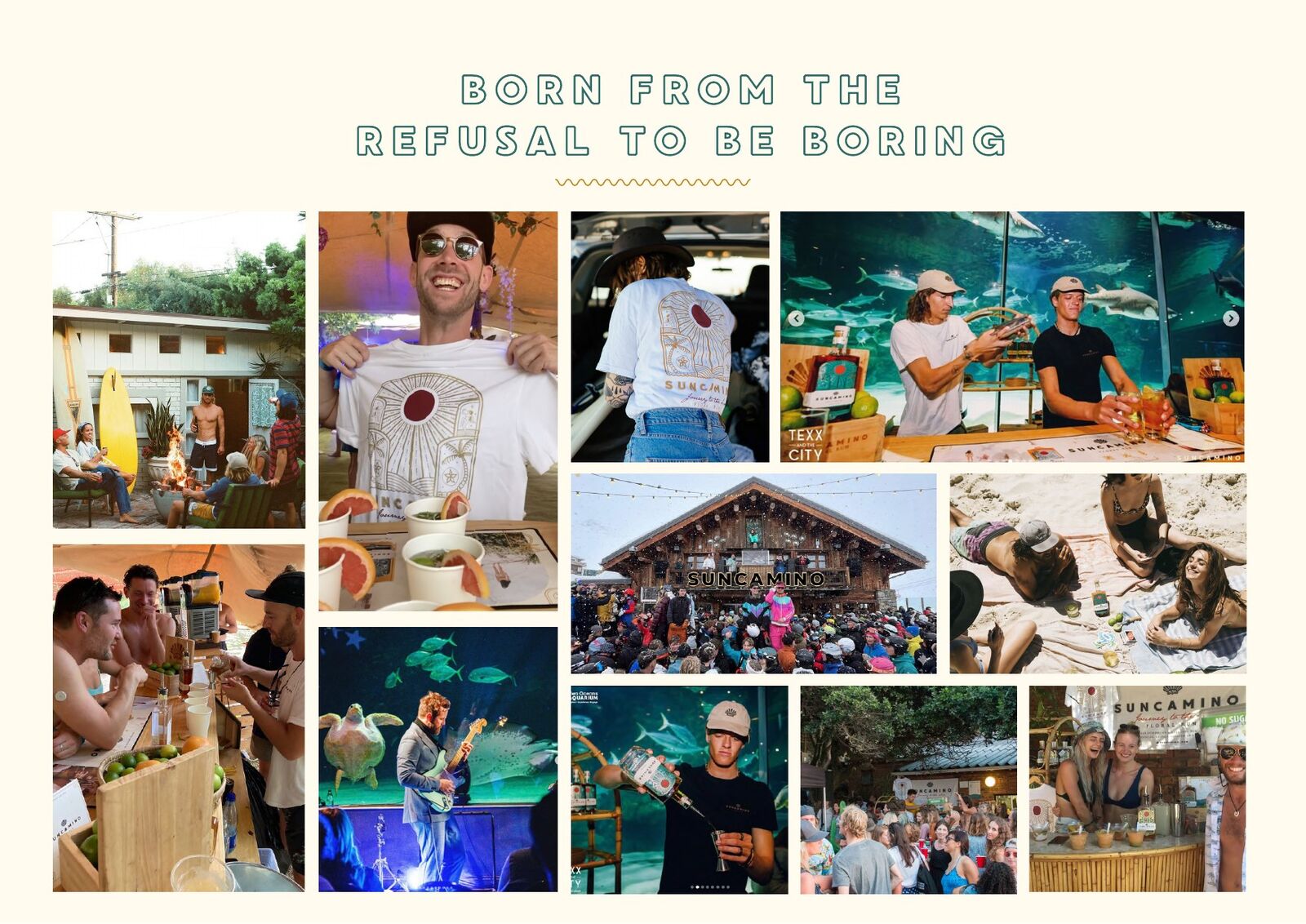
Born from the refusal to be boring
Worked. Ten photos of the brand in the wild. Aquarium tasting, ski-resort chalet, fire-pit with surfboards, festival bar, oceanarium. The exact venues a Dutch on-trade buyer instantly recognises — "this brand already plays in my world." Social proof at a glance.
One thing to push. A grid says "we're everywhere" without saying "where." Distributors count rooms, not vibes. One number under this grid would convert it from mood-board to evidence.
Even sharper. Caption strip: "Activated in [X] countries · [Y] trade events · [Z] brand partnerships since launch in 2021." The grid then earns its space twice — once on feeling, once on receipts.
Slide 5 of 18
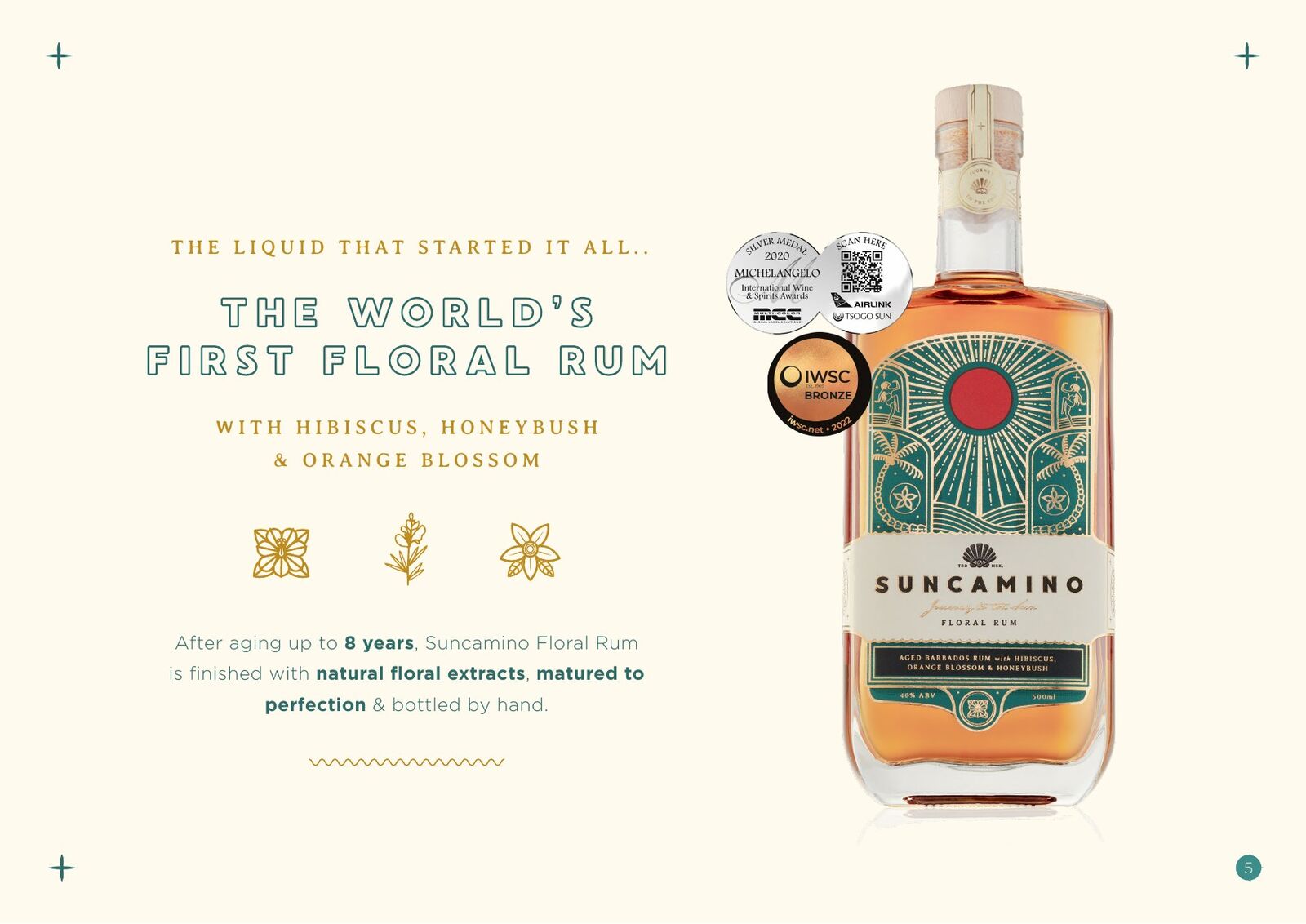
The world's first Floral Rum
Worked. The strongest single slide in the deck. Bottle photography is genuinely beautiful. Three awards in three years (Michelangelo Silver 2020, IWSC Bronze 2022, MCC). Hibiscus + honeybush + orange blossom is differentiated — "world's first" is a fact, not a tagline. 8-year aged Barbadian rum finished with South African botanicals = a story that pours itself.
One thing to push. The award medals are small. For a partner showing this to a buyer, the medals are the most cite-able artefact on the slide and they barely register at deck-zoom.
Even sharper. Enlarge the medal cluster 2× and add a one-line source: "2020, 2022 — judged blind." The fact that a Barbadian-aged rum won a *South African* spirits award the year it launched is exactly the detail that closes a sceptical buyer.
Slide 6 of 18
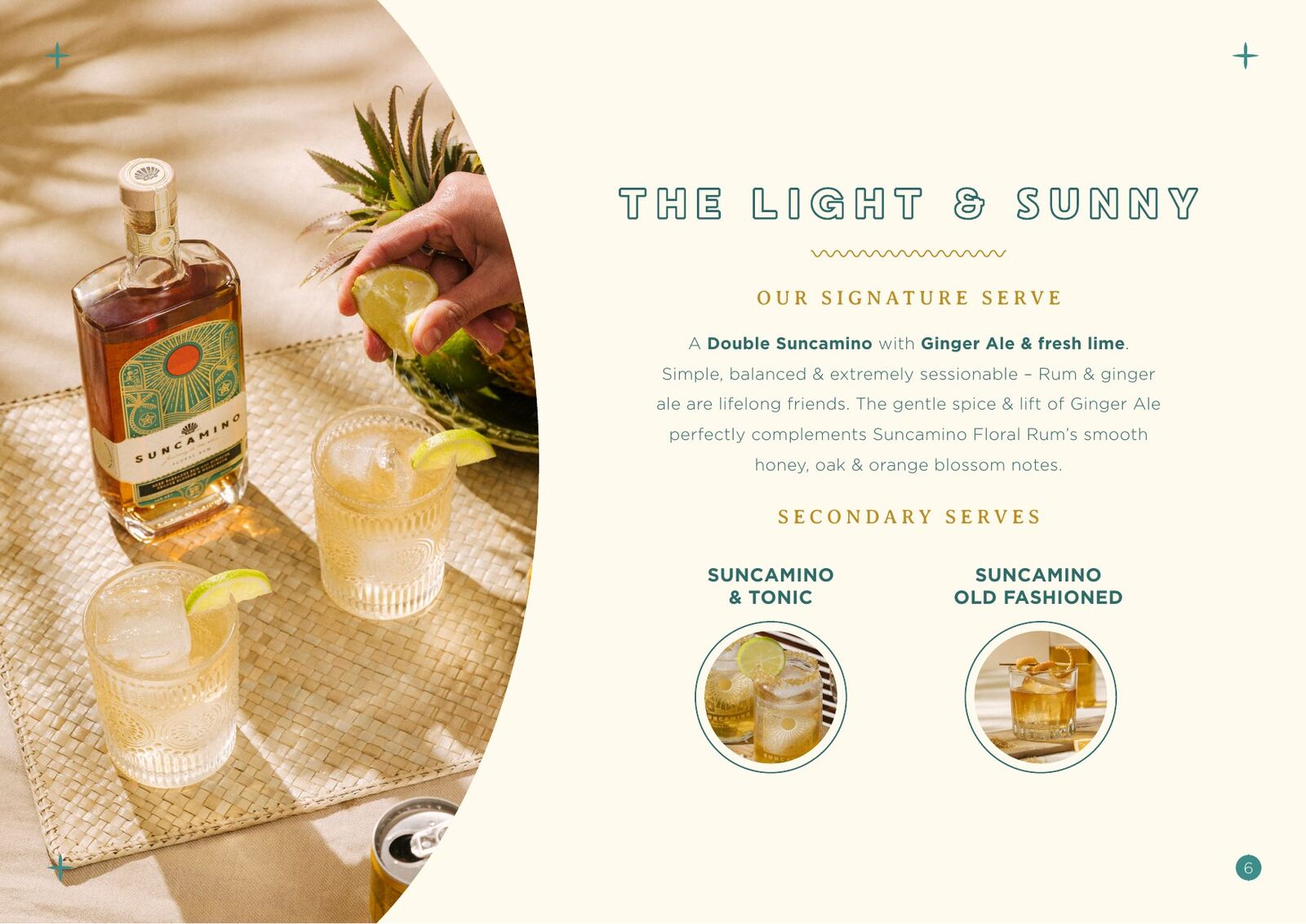
The Light & Sunny — signature serve
Worked. Signature-serve slides are the most-skipped slide in spirits decks and the most important one for a distributor — bartenders need to know what to pour from day one. Rum + ginger ale + lime is trade-friendly: no bespoke garnish, no obscure mixer. That scales behind a bar.
One thing to push. Two secondary serves sit as small circles below the hero. The on-trade buyer wants to know which one is the *volume* serve and which one is the *menu* serve — they're different jobs and different channels.
Even sharper. Pair each serve with the channel it wins. Light & Sunny → high-volume terraces & beach bars. Suncamino & Tonic → premium gastro on-trade. Old Fashioned → cocktail bars. Three serves, three rooms, one slide.
Slide 7 of 18
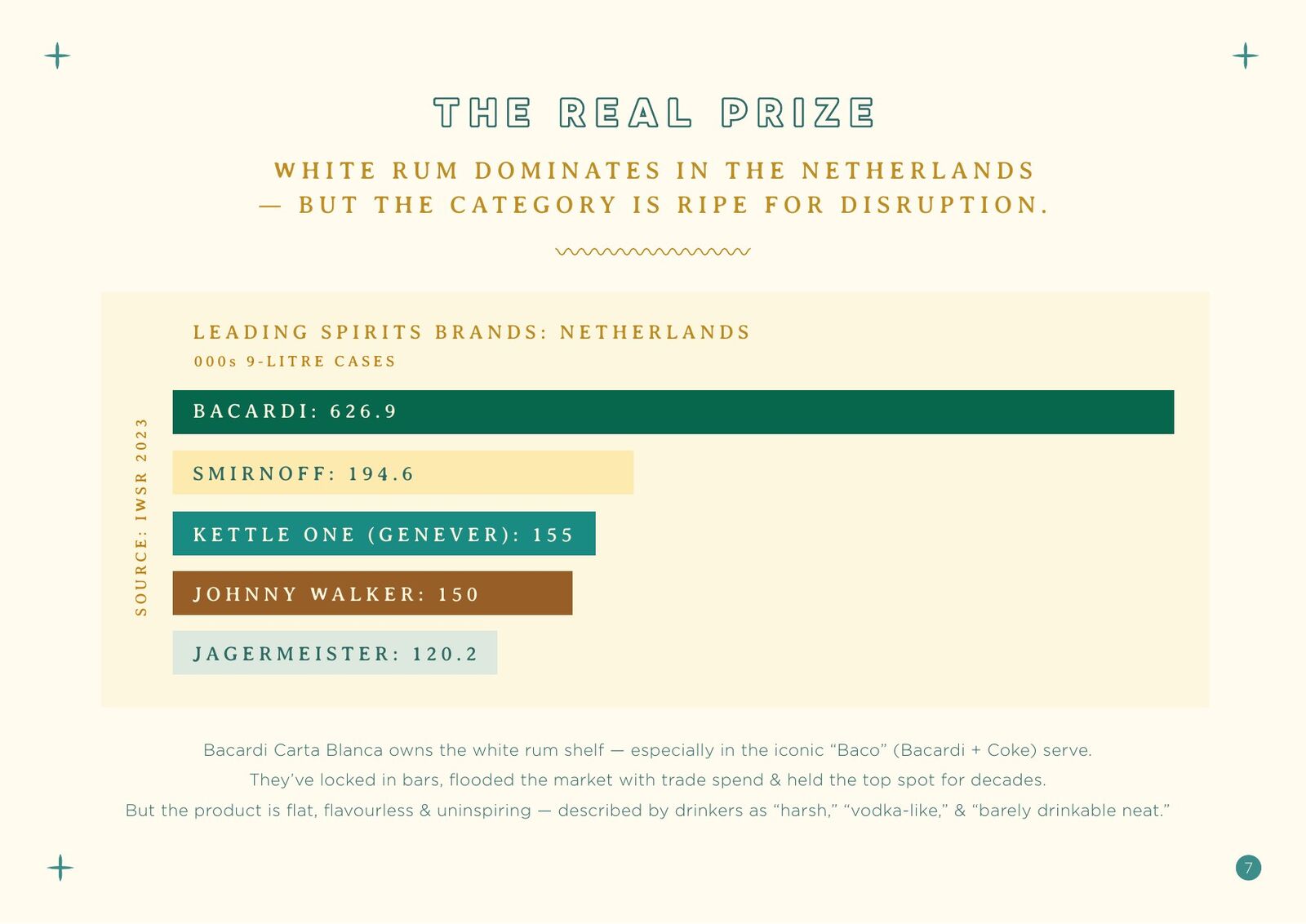
The Real Prize — NL white rum market
Worked. A properly built market slide. Specific market (Netherlands), specific category (white rum), specific incumbent (Bacardi at 626.9K cases), specific source (IWSR 2023). The closing line — "barely drinkable neat" — is genuinely good copy because it's a line consumers actually say, not a brand line.
One thing to push. Showing Bacardi at 627K vs the rest at 120–195K mostly tells the buyer "Bacardi is a monster." That's true but unhelpful. What the partner really wants to know is whether the rum sub-category itself is *growing* relative to gin and vodka.
Even sharper. Add one trend number — "NL white rum +X% volume in 2024 (IWSR)" — alongside the share table. If rum is moving while the brown-spirits shelves are flat, that's the trade buyer's reason to make space on the back-bar.
Slide 8 of 18
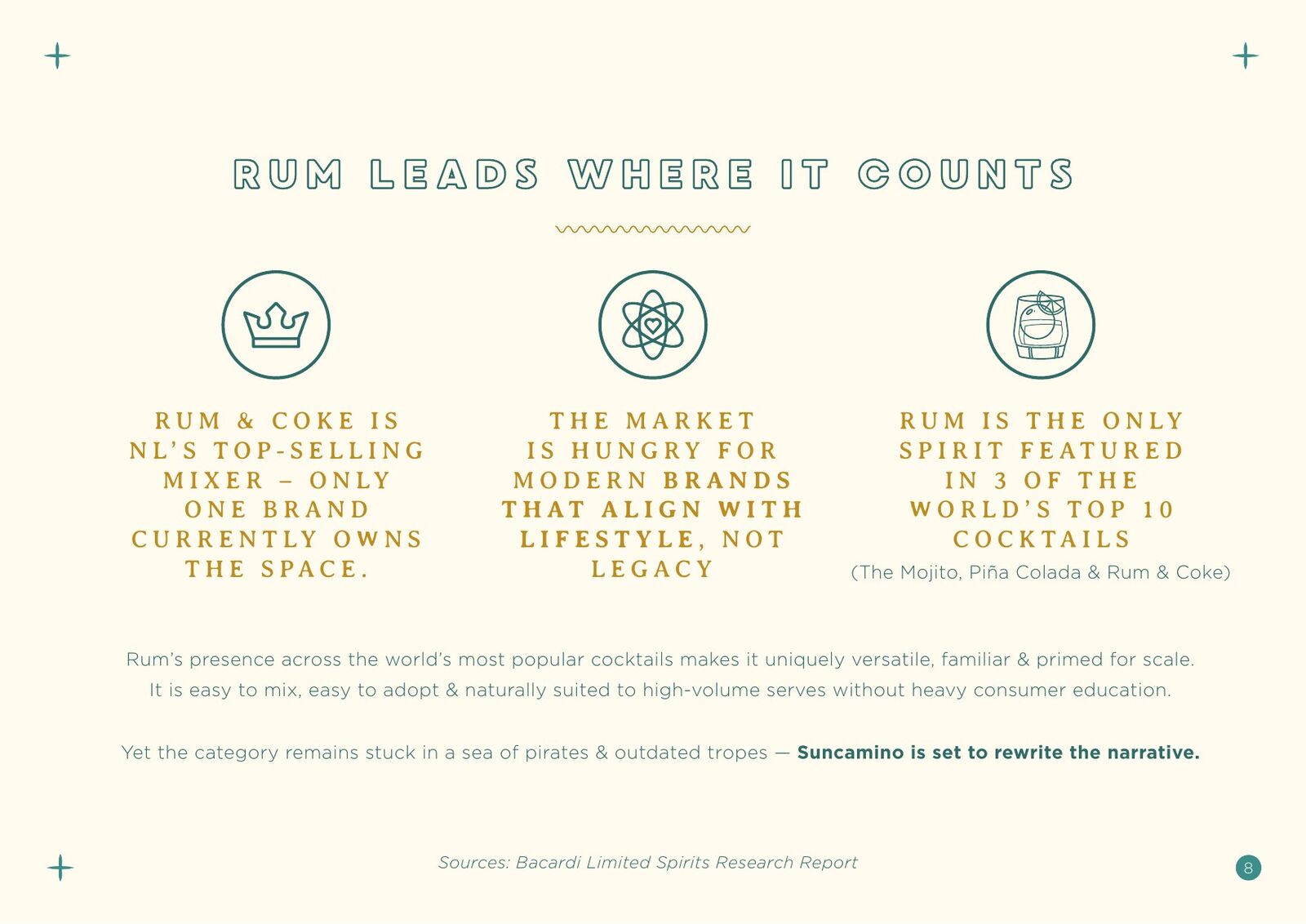
Rum leads where it counts
Worked. Three pillars (Rum & Coke = NL's top mixer; market hungry for lifestyle, not legacy; rum in 3 of the world's top 10 cocktails). The closing line — "Suncamino is set to rewrite the narrative" — is a partnership pitch, not a brag.
One thing to push. The "pirates & outdated tropes" line is true and well-said, but it's been the opening line of every modern rum brand since Equiano launched. The buyer's read it three times this quarter.
Even sharper. Replace that paragraph with one piece of evidence only Suncamino can claim. The Floral Rum is literally the world's first — that's already on slide 5. Cross-reference it: "The category needs reinvention. We already did it (slide 5)." Now the deck rewards the buyer who's reading it twice.
Slide 9 of 18
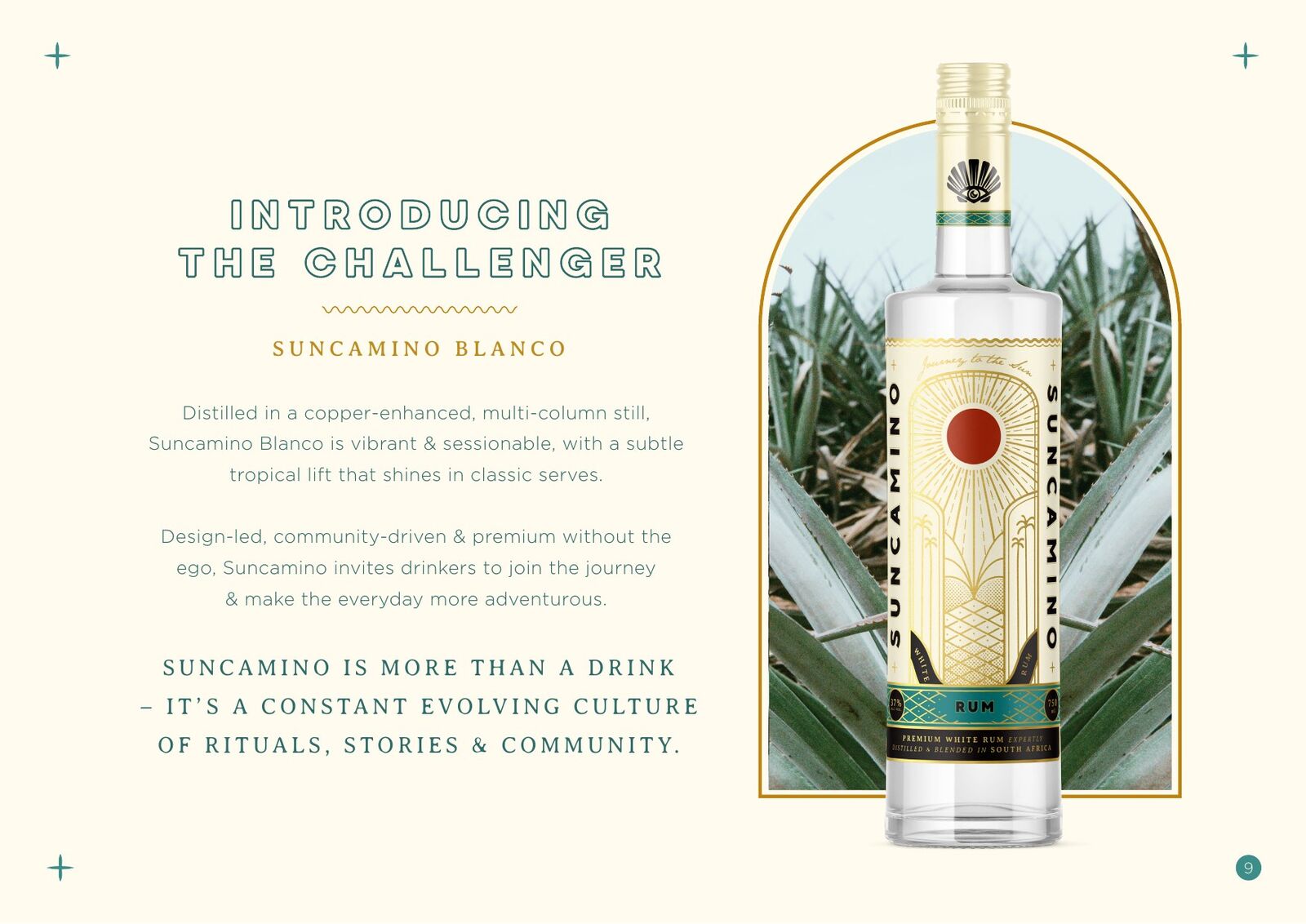
Introducing the challenger — Suncamino Blanco
Worked. Premium white rum, copper-enhanced multi-column still — a verifiable product spec, not marketing fog. "Premium without the ego" is a sharp positioning line. The bottle design carries the same DNA as the Floral Rum, which is *very* hard to do across two SKUs.
One thing to push. This is the slide that turns the partnership from "boutique Floral Rum" into "real volume play with a Bacardi-class shelf-anchor." That commercial weight isn't quite landing yet.
Even sharper. Add one strip under the bottle: "Blanco is the engine. Floral Rum is the halo. Together = premium positioning at volume price points." That sentence reframes the whole deck for the trade-buyer.
Slide 10 of 18
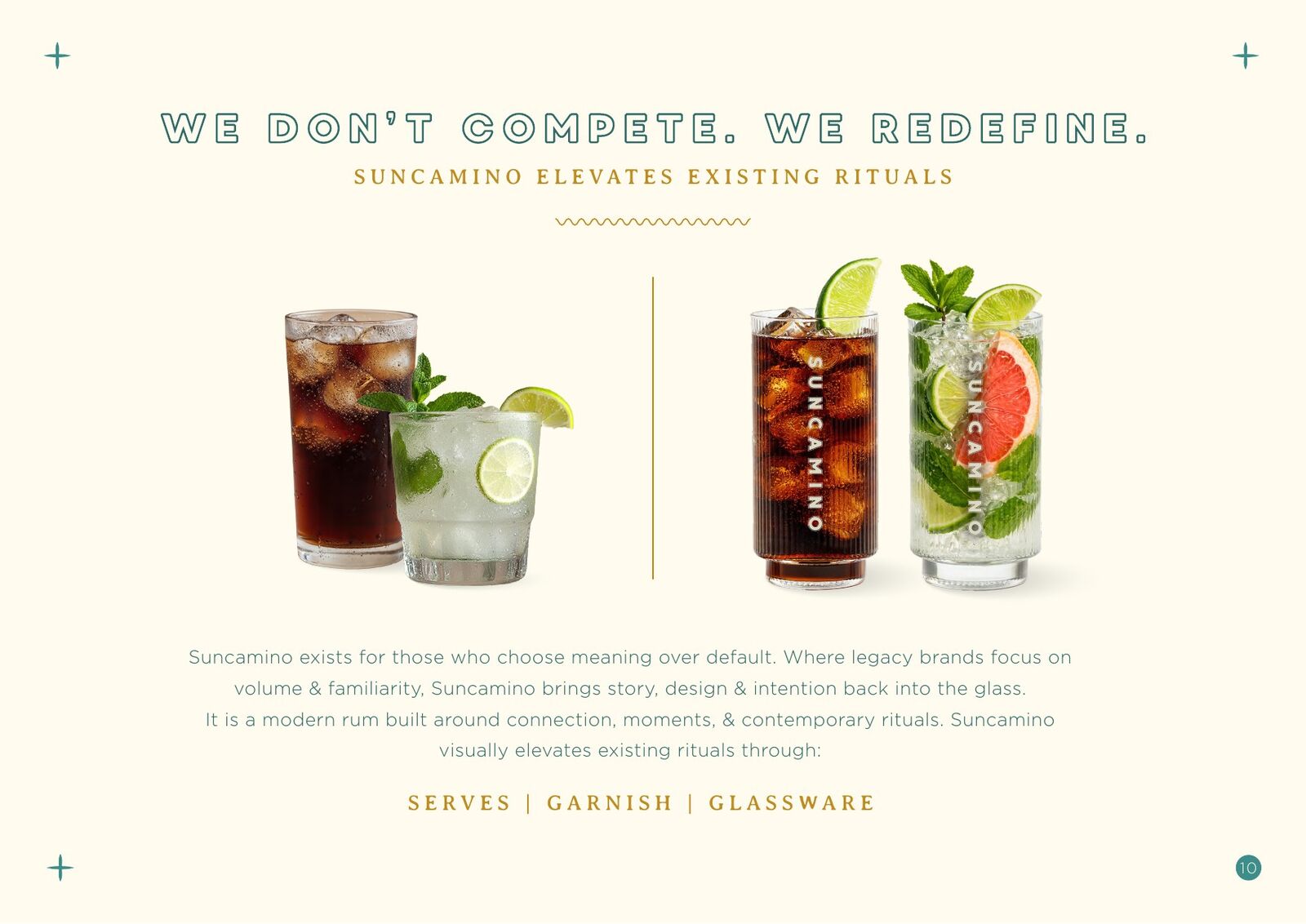
We don't compete. We redefine.
Worked. Side-by-side glassware comparison is a clever visual — same drink, branded glass, instantly elevated. Serves / Garnish / Glassware is a real on-trade lever and most spirits brands forget to articulate it.
One thing to push. The visual is strong; "redefine" is doing the heavy lifting on copy. A skeptical distributor reads "branded glassware" as "they want us to fund the glassware." Pre-empt the procurement question before it gets asked.
Even sharper. One line below the glasses: "Glassware funded by Suncamino in the launch phase — included in the €500K co-investment (slide 16)." Now the slide doesn't generate an objection, it answers one.
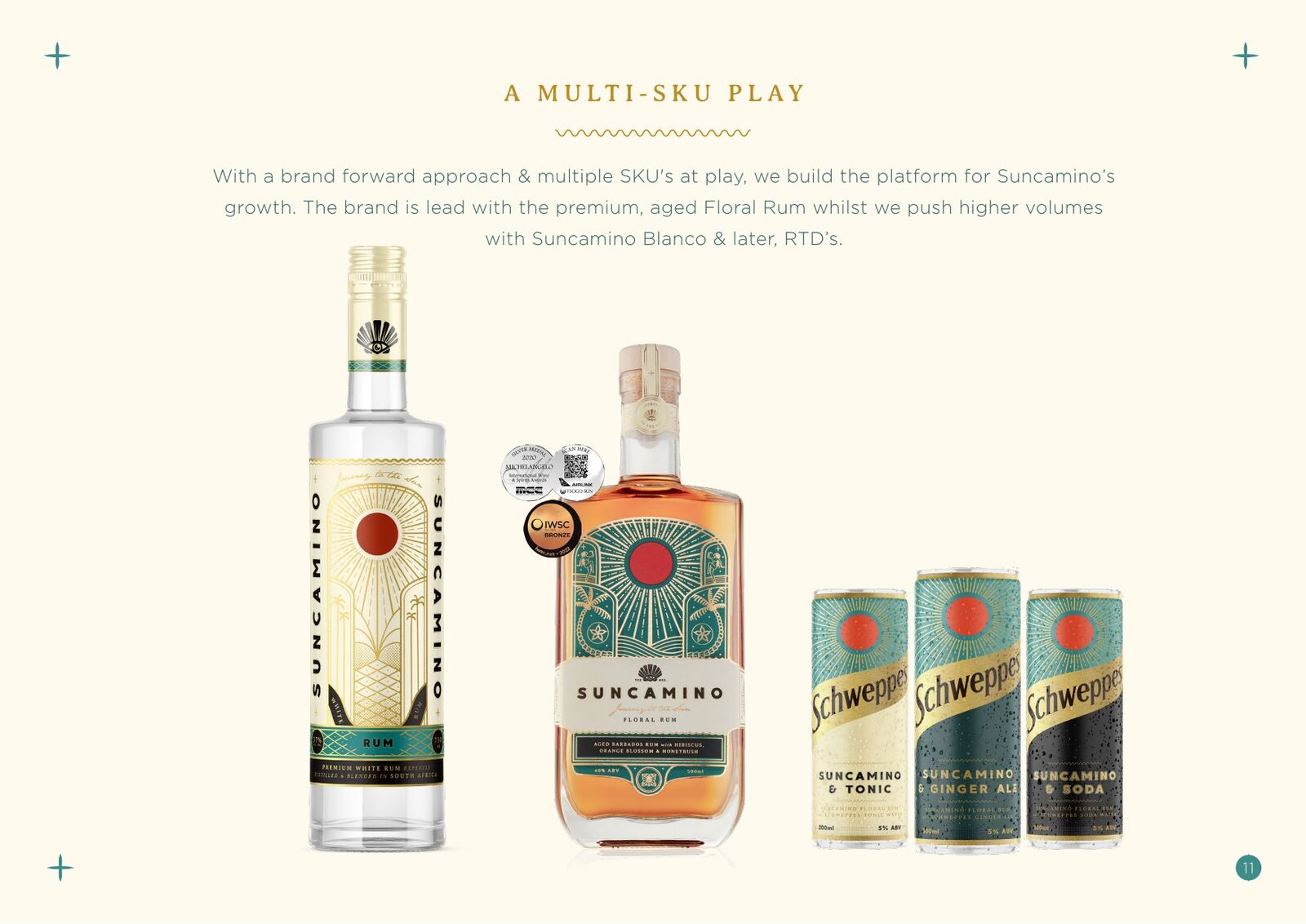
Slide 11 of 18
A multi-SKU play
Worked. Three SKUs on one slide gives the partner the full commercial picture — premium Floral Rum (margin), Blanco (volume), Schweppes RTD partnership (third shelf). That's a CPG strategy, not a one-product hope. The Schweppes co-brand is a serious commercial signal — multinational mixer + young spirits brand is rare.
One thing to push. The Schweppes story is currently presented as visual furniture next to the other two bottles. It deserves its own headline — that's the kind of deal that opens doors on its own.
Even sharper. Pull Schweppes out: "Co-launching RTD with Schweppes Q[X] 2026. Three SKUs, [country] retail, joint trade marketing." That's a partnership-deck-within-a-partnership-deck and it earns the slot.
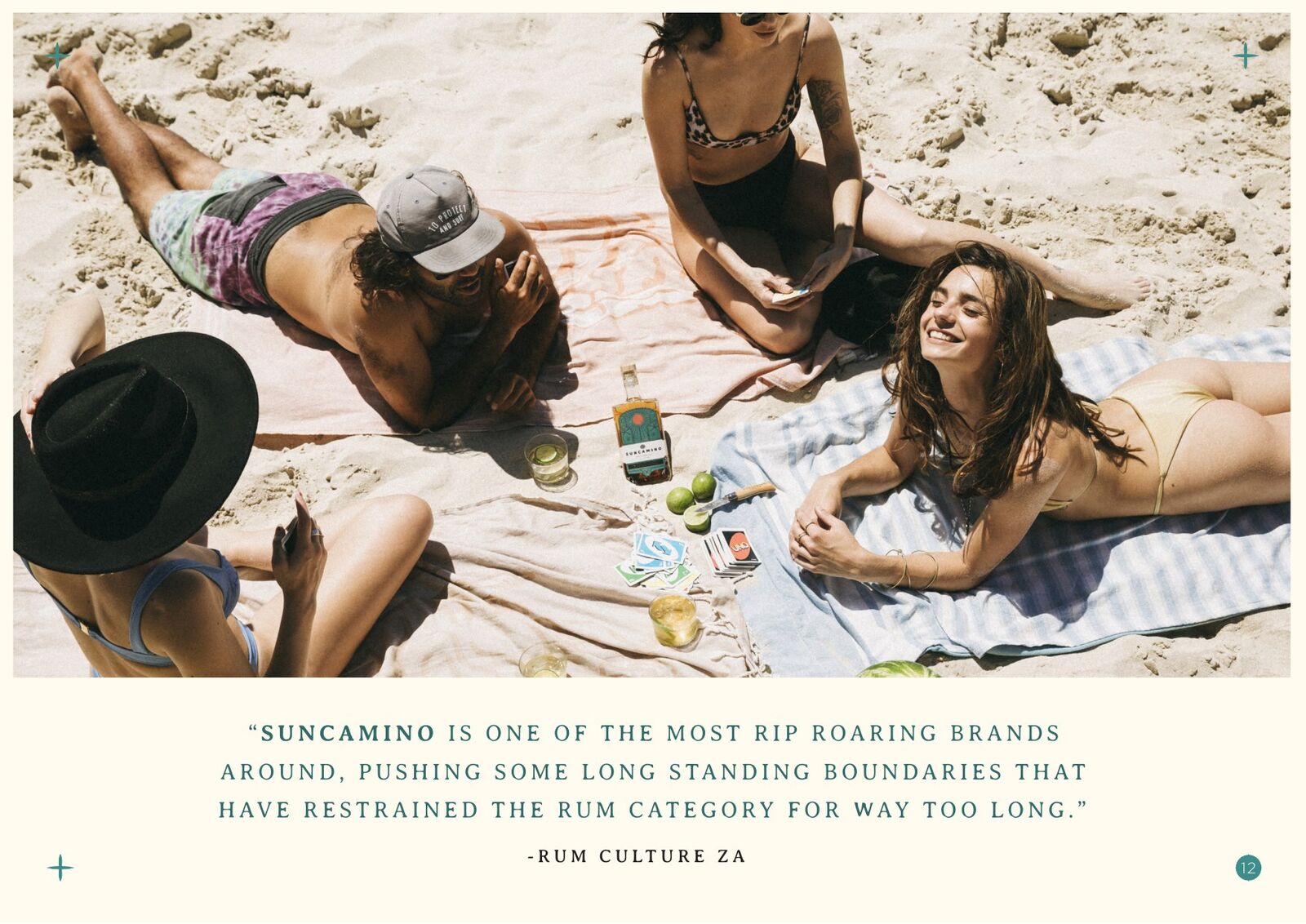
Slide 12 of 18
Rum Culture ZA testimonial
Worked. Third-party credibility from a category-specific publication, grounded in a lifestyle photo so the quote feels lived-in. "Pushing long-standing boundaries that have restrained the rum category" is the line a distributor will repeat to their buyer.
One thing to push. One quote does the job; two would compound it. For a partnership deck, what's missing alongside the consumer-press voice is a *trade* voice — a bartender or buyer who's actually moved the product.
Even sharper. Add a second tile: "Suncamino moves off our terrace faster than any new spirit we listed this season — [Venue], Cape Town." Trade voice + press voice = full triangulation, and the partner reads it as both proof and a playbook.
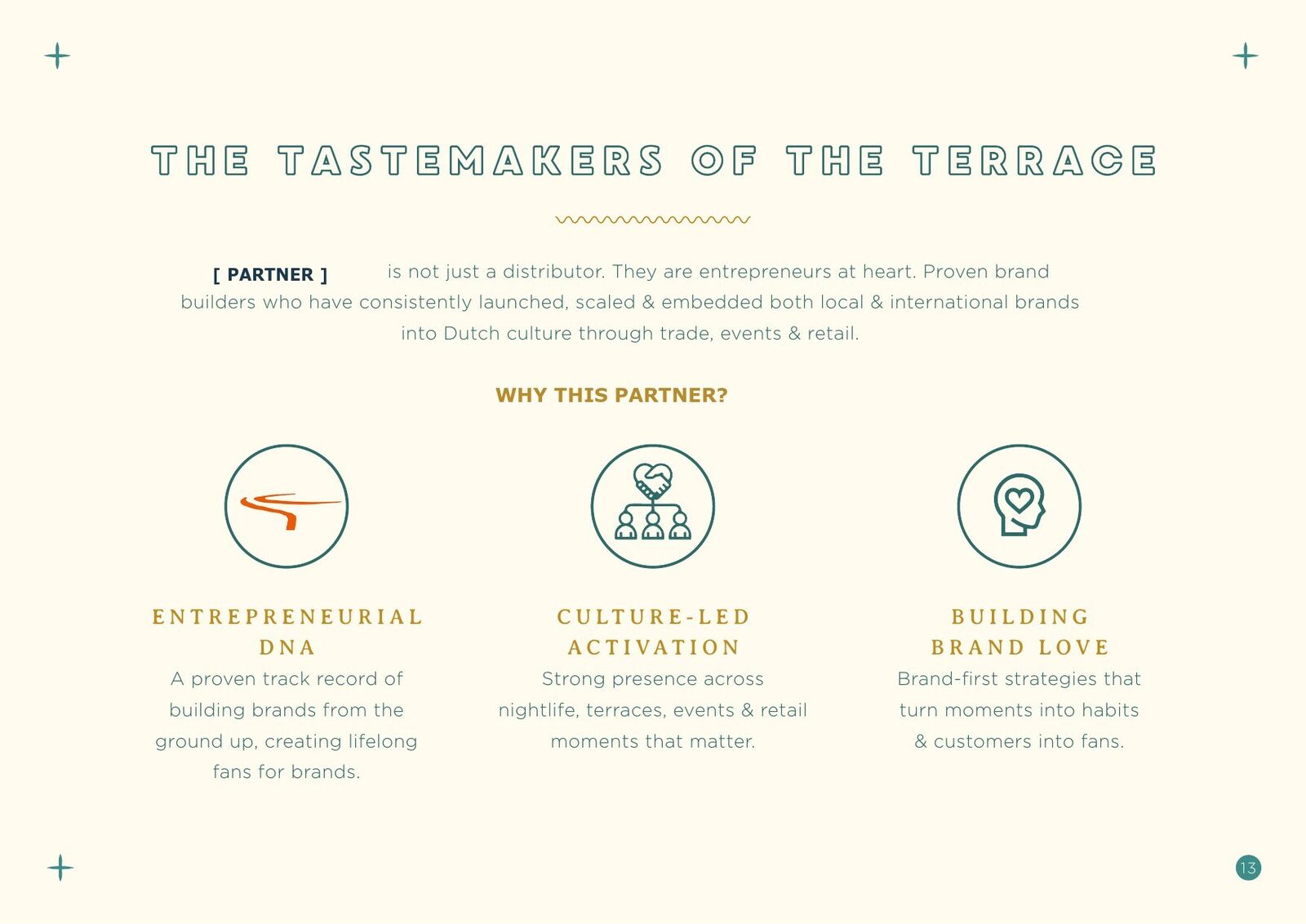
Slide 13 of 18
Tastemakers of the Terrace — partner credentials
Worked. Three pillars (Entrepreneurial DNA, Culture-led Activation, Building Brand Love). The deck *bends toward the partner* — treating them as a co-conspirator, not a vendor. Most decks I read forget to acknowledge what the other side brings. Suncamino doesn't, and partners feel that within 90 seconds.
One thing to push. The icons do generic work. The partner is reading this looking for themselves in it.
Even sharper. In any localised version of the deck, swap the icons for a logo-strip of the brands the partner has previously launched. Show the partner their own track record. Vanity is leverage — use it.
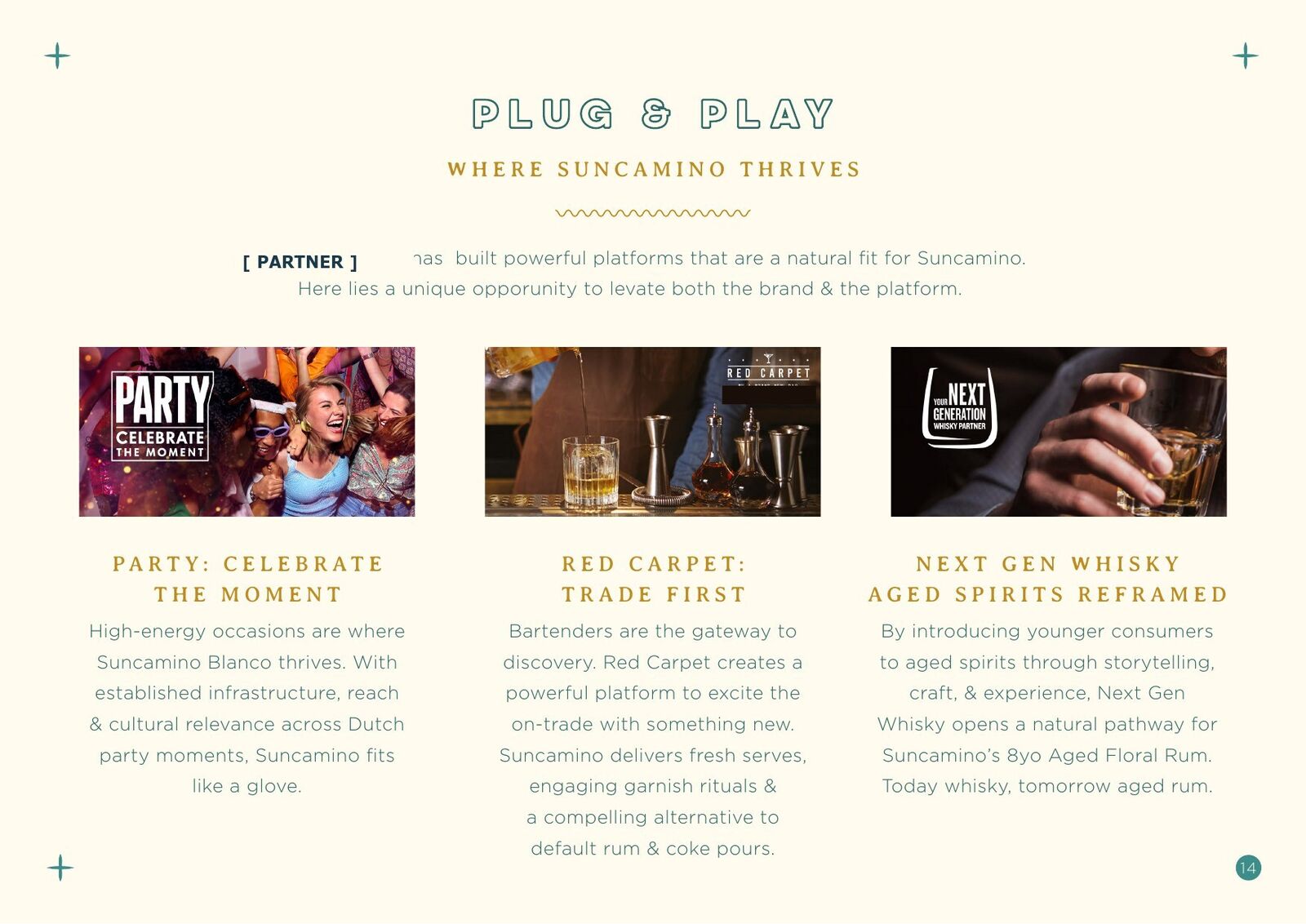
Slide 14 of 18
Plug & Play — where Suncamino thrives
Worked. Three concrete platforms, each with a clear job. Party = high-volume occasions for Blanco. Red Carpet = trade-first bartender discovery. Next Gen Whisky → aged Floral Rum is genuinely smart — the next-gen whisky drinker is the most natural Suncamino Floral Rum customer in the building.
One thing to push. Three platforms × three jobs is a lot for one slide. The aged-whisky-to-aged-rum thesis is the smartest insight in the deck and it's currently sharing airtime with two other ideas.
Even sharper. Either split into two slides, or compress to two platforms + a footer line: "Next Gen Whisky is the conversion funnel for the 8-year Floral Rum — today's whisky drinker is tomorrow's aged-rum drinker." Don't let the best idea share a slot.
Slide 15 of 18
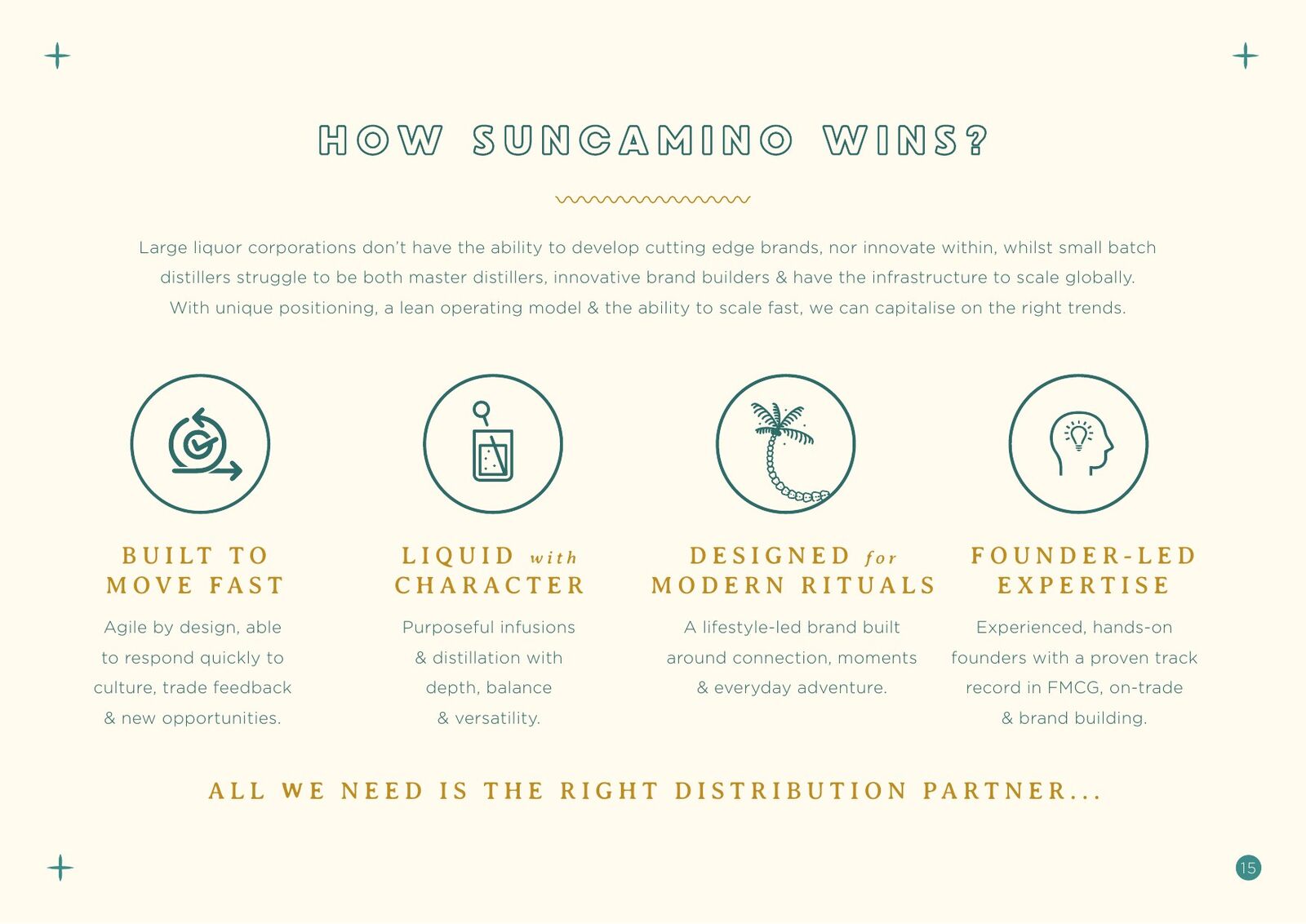
How Suncamino wins
Worked. Four-tile recap (Built to Move Fast, Liquid with Character, Designed for Modern Rituals, Founder-led Expertise). The closing line — "All we need is the right distribution partner" — is the perfect transition into the deal slide. Sequencing matters; this one's right.
One thing to push. Each tile carries a sentence. Sentences are softer than facts.
Even sharper. One specific number per tile. *Built to Move Fast* → "SKU brief to live in market in 90 days." *Liquid with Character* → "3 international awards." *Designed for Modern Rituals* → "4 signature serves built around 4 venue types." *Founder-led* → "11M+ drinks shipped across the founders' previous ventures." Same tile structure, 4× more defensible.
Slide 16 of 18
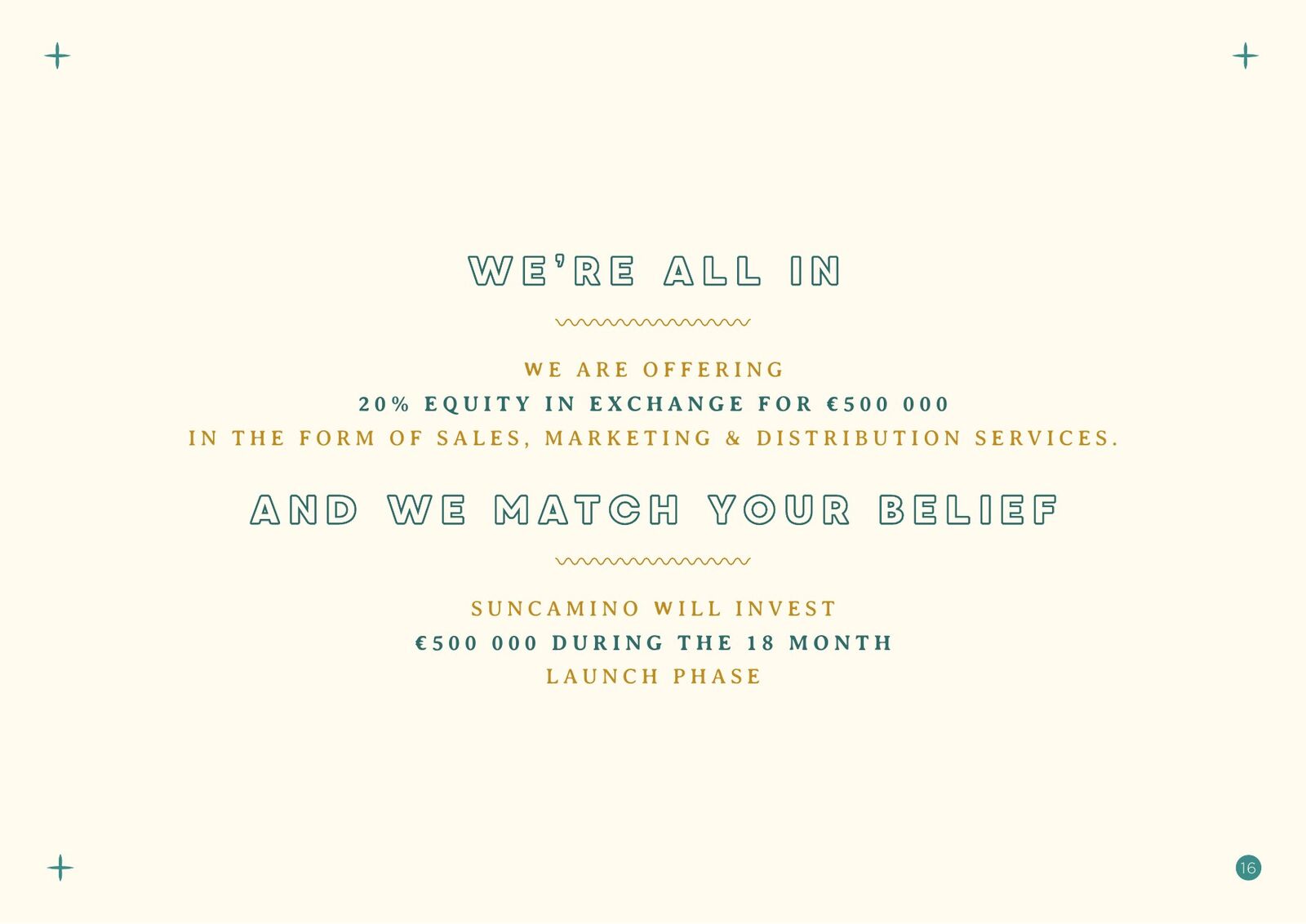
We're all in — deal structure
Worked. The slide that separates a serious brand from a hopeful one. Founders putting €500K of their own capital into the launch alongside a 20% equity offer for €500K of services. *Symmetric skin-in-the-game.* Most spirits brands ask distributors to fund the launch unilaterally; this one matches the bet.
One thing to push. 20% equity for services is a meaningful give. What's not on the slide yet is what €500K of "sales, marketing & distribution services" *actually buys* — doors, volume, marketing reach.
Even sharper. Small KPI strip: "€500K services unlock [X] doors yr 1, [Y] cases shipped, [Z] trade activations. €500K Suncamino co-invest goes into inventory + glassware + founder secondment to [market]." Now the equity is anchored to a measurable outcome, not a promise — and the partner can run their own ROI math.
Slide 17 of 18
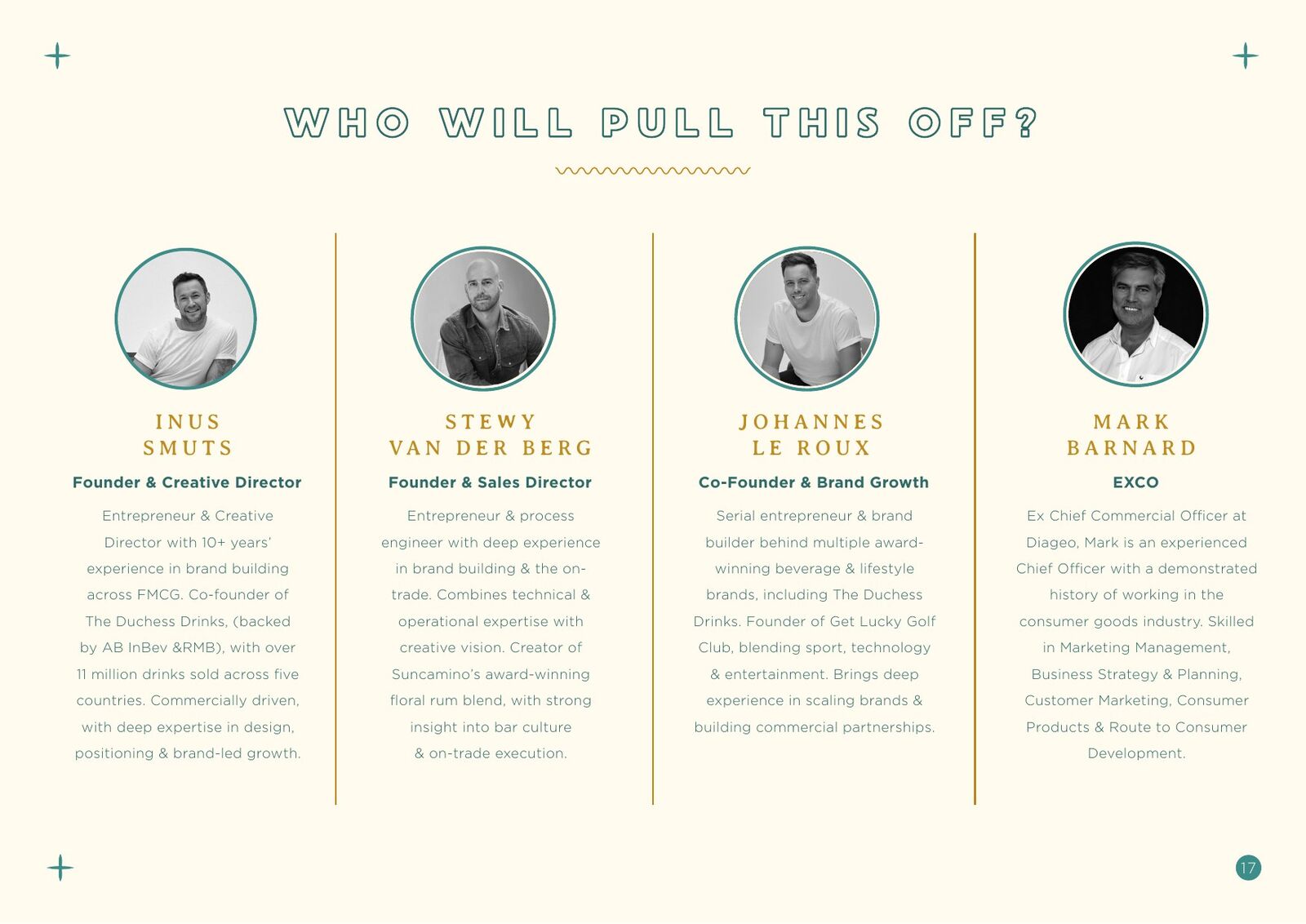
Who will pull this off — team
Worked. Four founders + operators with real CVs. Inus = creative lead + Duchess co-founder (11M drinks shipped). Stewy = on-trade operator + blend creator. Mark Barnard = ex-Diageo CCO — distributors recognise Diageo alumni instantly and weight them accordingly. (Including me on this slide is awkward, but for transparency: I'm a co-founder and brand-growth advisor on Suncamino.)
One thing to push. Like most team slides, the bios read as CVs ("experienced", "demonstrated history"). The partnership question is *what has this team shipped together*.
Even sharper. One founder-line each, anchored to what's been done *in service of Suncamino specifically*. Inus: "Designed Suncamino's IP and led the brand build since 2021." Stewy: "Sourced the Barbados base rum and built the on-trade launch playbook." Mark: "Joined the EXCO post-Diageo to take Suncamino international." That's the team a partner is buying.
Slide 18 of 18
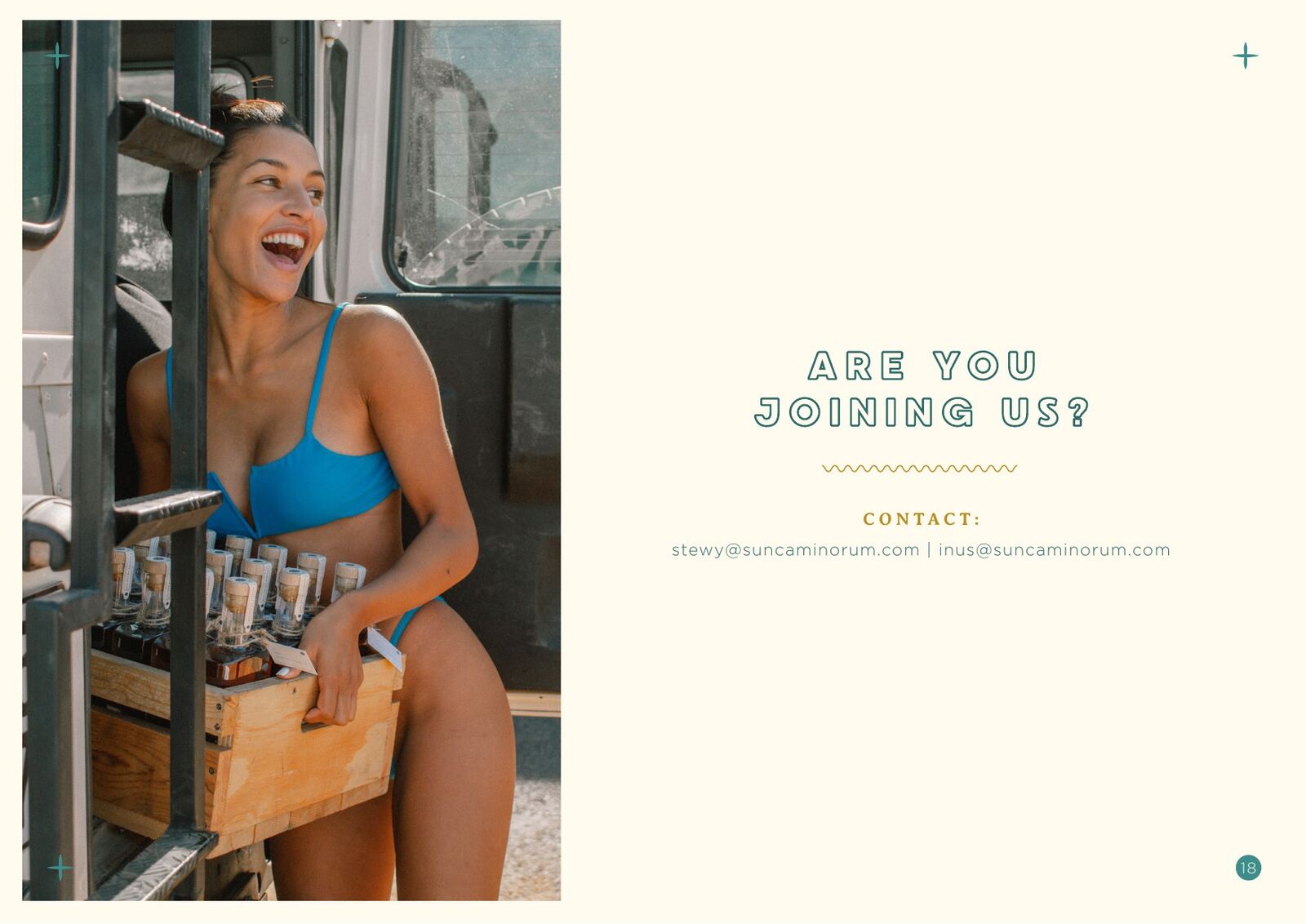
Are you joining us? — contact
Worked. Clean lifestyle photo, two founder emails. The aspirational image leaves the deck on a feeling, not a finance question. That's right for this brand — the close should feel like the opening did.
One thing to push. Same critique I'd give any deck — no explicit next step beyond two emails. What does the partner do in the next 7 days?
Even sharper. Bottom strip: "Next step: 30-min intro call. Book a slot: [Calendly link]. Or reply with three preferred times. Tasting kit ships within 5 working days of first call." Forcing function + frictionless follow-up. Tasting kits in particular convert at a wildly higher rate than "thanks for the deck" emails.
Patterns I keep seeing across partnership decks
- Skin-in-the-game beats slide design. Slide 16 is the slide most spirits brands don't have. €500K from the founders alongside €500K of partner services is the line that separates serious from hopeful.
- The signature serve is undersold everywhere. Distributors don't sell spirits — bartenders pour serves. Suncamino does it right by leading with a low-friction high-volume drink; most decks I review hide the serve behind product specs.
- Trade testimonials are rarer and more powerful than press testimonials. A bartender quote moves a buyer; a press quote moves a press release.
- Multi-SKU strategy beats single-SKU romance. Floral Rum (margin) + Blanco (volume) + Schweppes RTD (third shelf) is a real CPG strategy. A partnership ask resting on a single hero SKU is harder to close.
- The smartest insight is usually buried. Aged whisky → aged rum is the most defensible commercial thesis in this deck and it's tile #3 of 3 on slide 14. Best idea = own slide.
The biggest thing this deck gets right
It treats the distributor as a partner, not a vendor. Most spirits brands send distribution decks that read \"please carry our product.\" Suncamino's reads \"let's build a market together — here's our share, here's yours, here's the bet we're both making.\" That tonal shift is the difference between getting onto a back-bar and onto a roadmap.
I work on Suncamino as a brand-growth advisor, not the operator on the ground — Stewy & Inus deserve the credit for the brand, the liquid and the trade execution. My job has mostly been to push the narrative and the structure of decks like this one.
One more time
Want the redacted PDF in your inbox?
Drop your email below. I'll send you the redacted deck and nothing else unless you ask.